
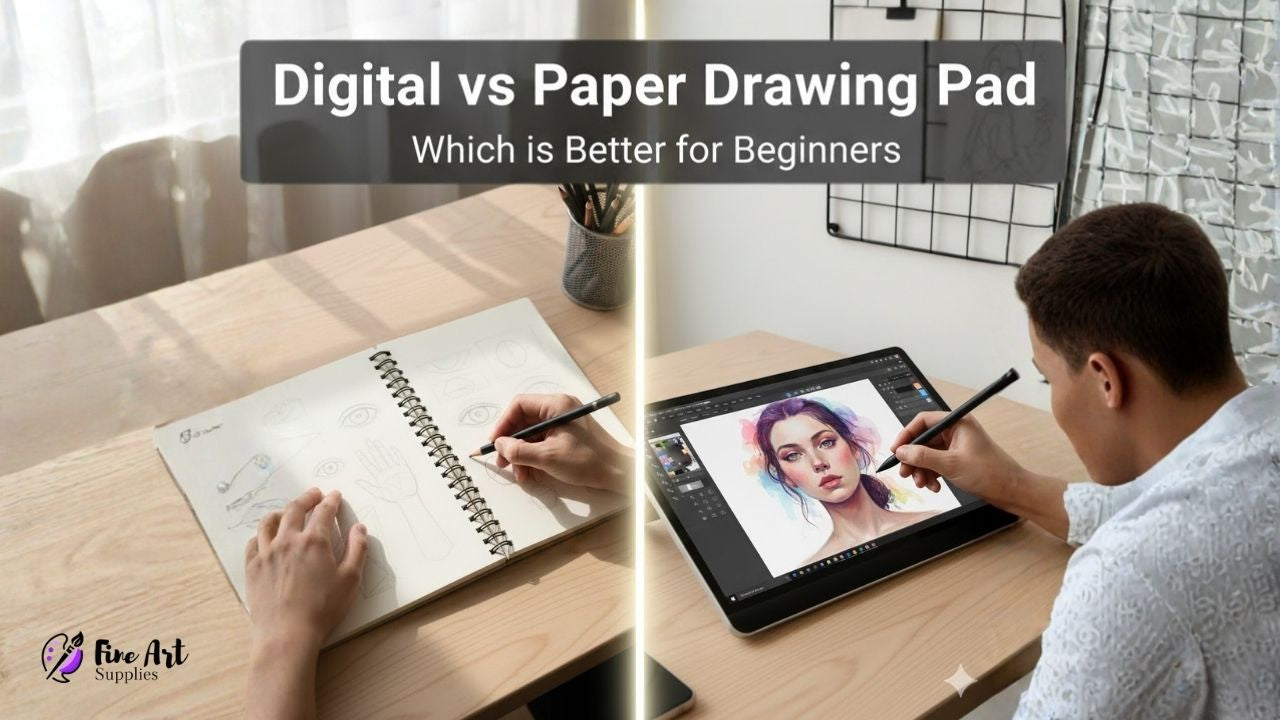
The surge in Pakistan's freelance economy has sparked a significant debate among aspiring artists: should you start your creative journey with a traditional pencil and paper, or jump straight into the digital world with a graphic tablet? With the rise of digital illustration in cities like Lahore, Karachi, and Islamabad, many beginners feel pressured to go digital immediately to stay relevant. However, the choice isn't just about technology; it’s about how you learn to see, feel, and create.
Understanding the fundamental differences between these mediums is essential before you invest your hard-earned money. Whether you are a student at NCA or a hobbyist looking to start a side hustle on Fiverr, choosing the right foundation will dictate how quickly you master the basics of anatomy, perspective, and shading.
The Tactile Experience of Traditional Paper
There is an irreplaceable connection between the hand and a physical drawing pad. For a beginner, the "tooth" or texture of the paper provides immediate tactile feedback. When you pull a graphite pencil across a high-quality sheet, the friction helps you control your lines. This resistance is crucial for developing muscle memory, a vital skill that every artist needs.
Traditional drawing forces you to be intentional. There is no "undo" button (Ctrl+Z) on paper. If you make a mistake, you have to find a creative way to fix it or carefully erase it. This limitation is actually a teaching tool; it encourages you to think twice before making a mark and helps you understand the weight and pressure of your hand. For those who want to experiment with heavier mediums, moving from paper to canvas art sheets offers a bridge into the world of professional painting.
The Learning Curve of Digital Graphic Tablets
Digital drawing pads, or graphic tablets, offer an incredible range of tools in a single device. You have access to thousands of brushes, infinite colors, and layers that make complex compositions much easier to manage. For a beginner in Pakistan looking to enter the commercial market, digital skills are highly sought after.
However, the digital medium comes with a unique challenge: the "hand-eye coordination" gap. Unless you are buying an expensive pen display (where you draw directly on a screen), you will likely start with a pen tablet. This requires you to look at your monitor while your hand moves on a separate black surface. This disconnect can be frustrating for someone who has spent years doodling in notebooks. Furthermore, the glass-like surface of many tablets lacks the natural friction of paper, often making your lines feel shaky or "slippery" at first.
Cost Considerations in the Pakistani Market
Price is a major factor for most local artists. A high-quality physical sketching kit is relatively affordable and accessible. You can start with basic Fine Art Supplies and upgrade as your skills improve. Paper is portable, requires no electricity, and doesn't suffer from software glitches or driver issues.
On the other hand, a digital setup is a significant upfront investment. Beyond the tablet itself, you need a computer with decent specifications and software like Adobe Photoshop or Clip Studio Paint, which often require monthly subscriptions. While digital art saves money on recurring costs like buying new pads every month the initial barrier to entry is much higher in terms of PKR.
Why Starting Traditional Often Leads to Better Digital Art
Most professional illustrators recommend starting with paper for a simple reason: the fundamentals are easier to grasp when you aren't distracted by software features. When you use a traditional pad, you focus entirely on the light, the shadow, and the form. In a digital environment, beginners often get distracted by "special effect" brushes or color filters before they even understand how to draw a proper circle.
Once you have mastered the basics on paper, transitioning to digital becomes a matter of learning a new tool rather than learning how to draw from scratch. The skills you gain while handling Different Types of Craft Accessories and various traditional textures give you a deeper appreciation for how digital brushes are designed to mimic real-world physics.
Making the Final Decision
So, which is better for a beginner? If your goal is to build a rock-solid foundation and understand the "soul" of drawing, start with a physical pad. The discipline it builds is invaluable. If you are already tech-savvy and your primary goal is to start a freelance career in UI/UX or digital character design as quickly as possible, you might find the digital route more direct.
Ultimately, the best artists are usually "hybrid." They sketch their ideas on paper to maintain that raw, organic feel and then move the work to a computer for final polishing and coloring. No matter which you choose, the most important thing is consistency.
Frequently Asked Questions
1. Is digital art "cheating" because of the undo button?
Not at all. Digital art is just a different tool. While the undo button and layers make the process faster, they don't teach you composition, color theory, or anatomy. You still need artistic skill to make a digital piece look good.
2. Which digital tablet is best for a beginner in Pakistan?
For beginners, brands like Huion and XP-Pen offer great value for money and are widely available in Pakistan. They are generally more budget-friendly than Wacom while offering similar pressure sensitivity.
3. What paper thickness (GSM) should I look for in a drawing pad?
For general sketching with pencils, 100-120 GSM is fine. However, if you plan to use ink or light markers, look for 150-180 GSM to prevent bleeding.
4. Can I learn to draw on a mobile phone?
While possible with a stylus, the small screen size makes it difficult to learn proper arm movement. A tablet or a physical A4-sized pad is much better for learning.
5. How long does it take to get used to a graphic tablet?
Most artists take about 2 to 4 weeks of daily practice to overcome the hand-eye coordination gap of a non-screen tablet.
6. Do I need to be good at drawing on paper to be good at digital art?
It isn't a strict requirement, but it helps immensely. Most of the world's top digital artists spent years practicing on paper first.